Reincarnation: Choosing your Life

Reincarnation: Choosing your Life

Dr Wambach discovered that folks choose their lives. They may choose the life themselves or they may receive help and advice in choosing. We may of course not be all that keen to reincarnate again but it does appears that returning to a physical incarnation is something we accept as a natural part of our development process. Many readers might think, ‘No way, I would never have chosen this life,’ but if things appear difficult then that is because there are challenges to be overcome in every life. Dr Wambach also discovered that folks incarnate with other people they have known from previous lifetimes. This can be because we have relationships to work out between those individuals, perhaps we didn’t get on in a past life so this time we can try a bit harder. Or they are people we incarnate with who have chosen to work with us and help us through difficult times or help us to achieve certain objectives. There are many permutations and it must quite a logistical headache for the giant ‘spirit computer’ in the sky to bring it all together.

arjuna battleThinking about choices in life I’m reminded of the Bhagavad Gita which I came across many years ago when I was hungry for all thing to do with reincarnation. The Gita is part of the epic Mahabharata Hindu text. In the Gita, Prince Arjuna an acclaimed archer is about to start a battle against a rival family who are after his kingdom. The two armies are massed ready to fight. Arjuna is fortunate to have one of the Hindu deities Lord Krishna as his chariot driver. Arjuna though has a crisis just before the battle, he sees his relatives, teachers and friends in the two armies and his self-assurance melts away. His bow slips from his hands and he sits dejectedly in his chariot his eyes filling with tears. He tells Krishna. “I cannot slay my kinsmen not for all the three worlds much less a kingdom.” Krishna turns to Arjuna and says, “This is your hour of trial Arjuna, such base despair does not become you, it is inappropriate. The call to battle has already been sounded arise and take up your arms.” This surprising response from Krishna is followed by telling Arjuna, “The soul in man is neither born nor can it die. Weapons cannot cut it. Fire cannot burn it. Water cannot wet it. Wind cannot dry it. What makes you think you can kill the soul? Just as a man discards old clothes and wears new ones the eternal soul sheds a dead body and enters another.”

reincarnation7_battleSo Krishna is telling Arjuna to stop feeling sorry for himself and do his duty and get on with the battle. You can kill your enemies but not their souls which reincarnate in new bodies. Now you would be forgiven for thinking Arjuna has a point, why start a war against your relatives, surely there must a better way. But we have Krishna in the driving seat and Krishna has a different view on the matter. Pretty unlikely I know but if Jesus had been Arjuna’s chariot driver it would have been a case of turn the other cheek, make up and let’s go home for a spot of supper. Not so with Krishna. although I have read many interpretations of the Gita I still feel a little uncomfortable about it. Krishna does finish off his pep talk to Arjuna with a fantastic spectacle where Krishna reveals himself to Arjuna in his divine form. This does the trick and Arjuna goes on to win the battle and keep his kingdom. We can see Krishna’s point of view as well in that Arjuna has a job to do in fulfilling his destiny, overcoming his doubts and defeating his enemies. Good triumphing over evil and you could argue its a life lesson for the vanquished foes to suffer and perhaps that was one of their lessons they incarnated to learn.

So in our owns lives there are occasions when we have to make life changing decisions and it’s hard. We have to sleep on it, discuss it with close friend’s because that’s maybe why they incarnated at the same time to help us make the right choice.

4464516033_e0482e3980
“The god Krishna explains karma yoga to Arjuna. He tells him he must act, but not be attached to the fruits of his actions. He must fulfil his duty as a warrior and fight for good to triumph over evil. Krishna reveals his divine form to Arjuna on the battlefield. As he does Arjuna sees the whole universe subdivided into many worlds but united in the body of the highest Deity.”
Christianity and Reincarnation


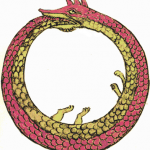
Ouroboros 

 Christianity and Reincarnation

The early Christian Gnostics used the symbol of Ouroboros a dragon swallowing its tail signifying the wheel of death and rebirth. The Gnostics aspired to become living Christs, beings that ultimately conquer spiritual ignorance. This transformation was to happen not after death but on earth within a physical body. Failure to achieve this goal meant being trapped in the death and rebirth cycle of Ouroboros. In the Gnostic “Secret book of John,” written before 185 A.D. Jesus explains to the apostle John that human souls are recycled by Jehovah, constantly thrown into forgetfulness and prisons, (prison here refers to the gnostic term for the physical body). John asks him how a soul can become liberated from the Ouroborous. Jesus answers saying ‘This soul needs to follow another soul in whom the Spirit of life dwells, because she is saved through the Spirit. Then she will never be thrust into flesh again.’  Thrust into flesh means reincarnation a term which has all but disappeared from the bible. 

To understand why reincarnation was removed from the Christian teachings we need to consider the role of the roman emperor Justinian who in 545 A.D. was able to apply the full power of Rome and his authority to stop any teaching of reincarnation. He forced the ruling cardinals to draft a papal decree stating that anyone who believes that souls come from God and return to God will be punished by death.

Justinian was advised by his bishops that a belief in reincarnation meant that people would think themselves the equal of Jesus who of course also came from God into a physical body. This means the church would not have control over people if those people believed that like Jesus they originated from God.

So the decree turned this around by stating that God creates souls at the moment of conception and souls could only go to heaven if they followed the church’s teachings. This was a great way of keeping control over people because if they didn’t follows the church then damnation would be the result. So in one decree reincarnation was wiped from Christian teachings and has never been reinstated. Essentially it suited the church quite nicely to keep the people in ignorance believing the only way to salvation was by devotion to the church otherwise a life of eternal torment in hell would result after death.

The downside to this of course was that bad people might think well I’ve been bad so I’m doomed might as well carry on and be bad and reject the church. So the church introduced confessions which means people who had done ‘bad’ things could confess their sin and be given a mild punishment to absolve them from wrongdoing and get them back into the fold. The state known as purgatory was also conceived which meant if you were reasonably good but a bit sinful then a period in purgatory, (which is a place not as bad as Hell but still a bit rough), could absolve you from your sins and make you ready for heaven.

Later on the church realised there could be profit in extending this to the granting of indulgences which means those with money could buy their way out of sin and still get into heaven by purchasing some of these indulgences. A kind of ‘get out of jail free’ card which became very prevalent in medieval times.

Indulgences and purgatory eventually ran out of credibility and fashion. The modern view is that indulgences have been toned down and involve a fair bit of penance and not cash to gain your way to salvation. Similarly purgatory is still believed in in the Catholic Church but its role is played down and treated as a step on the way to heaven.

Reincarnation is certainly not part of the thinking of the Catholic and Anglican churches and probably never will be. Interestingly Dr Wambach was expecting some flak from the church over her research findings but to her surprise the church, especially some of the “born agains” regarded it as proof of an afterlife even if they didn’t all together agree with the mechanism of reincarnation.

David Pye, February 2016


What happens when we die?

What happens when we die?

As a child trotting off to Sunday school at weekends I felt very uncomfortable with the notion of a heaven that we all go to when we die. According to Christianity God creates a new soul at the moment of conception, so having created all these souls God has to do something with them when the body dies. It just seemed to my young brain that if everyone floated off to heaven when they die then the place would be heaving with billions and billions of souls. ‘Where would they all fit’ I asked and ‘what would they do all day.’ ‘The Lord moves in mysterious ways’. came the answer. Well he certainly would have to, I thought, to fit all that lot in!
It also seemed totally unjust that some people are born into privileged lives with long life spans and others can be born into a famine zone in Africa and die of malnutrition at the age of 12 months. Where is the equality in that?

It was by reading the books of Lobsang Rampa when I was 13 that I learned about reincarnation, ‘that sounds far more sensible’ I thought, ‘much more of a level playing field.’ Now I know old Lobsang turned out not to be a Tibetan lama but a plumber from Devon but that didn’t matter as he set me off down the path of eastern philosophy and it all made much more sense.

Although Hinduism and Buddhism explained about the wheel of karma, birth and death and striving to get off that wheel to reach enlightenment I felt it wasn’t that clear on the mechanism behind how lives are chosen. There was always this uncomfortable impression that you could return as an animal as punishment for bad karma or past life misdemeanours. That seemed unfair to animals that they were regarded as lesser creatures and it didn’t feel like an efficient system that your ‘soul’ could be bobbing about between animal and human incarnations. What’s the point behind it all I wanted to know.

Coming across the work of Dr Helen Wambach revealed the mechanism behind reincarnation where human souls continually incarnate as humans and not as animals. As you will see by reading the research for yourself there appears to be a complex mechanism and a grand plan for life on earth. We are incarnated here many times to learn, experience and achieve certain objectives that will add to the greater knowledge of the universe.